The Gartner Marketing Symposium/Xpo 2026 brought together roughly 2,500-3,000 senior marketing leaders at the Gaylord Rockies in Aurora, Colorado from June 8-10, with 71% at the director level or above and 93% involved in technology purchase decisions. Over three days, the conversation focused on a question the industry has been circling for the past two years: what does it really take to build an AI marketing organization?
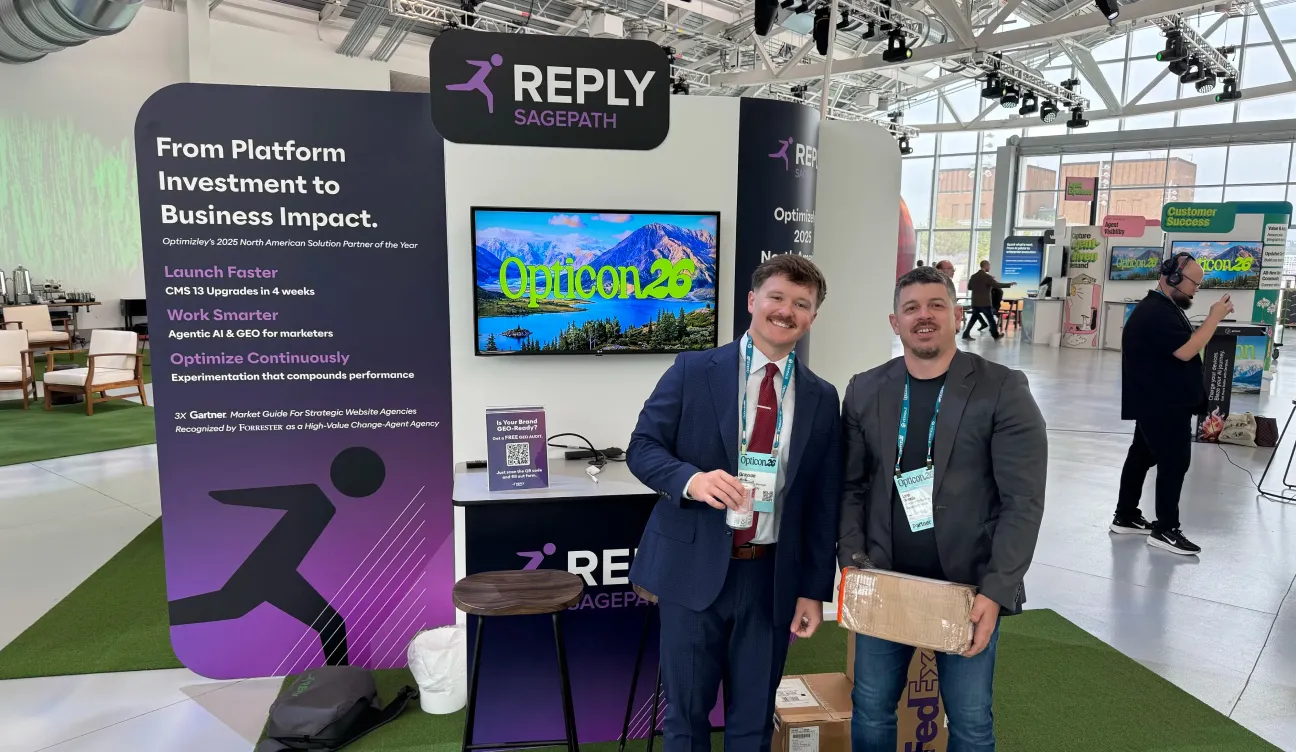
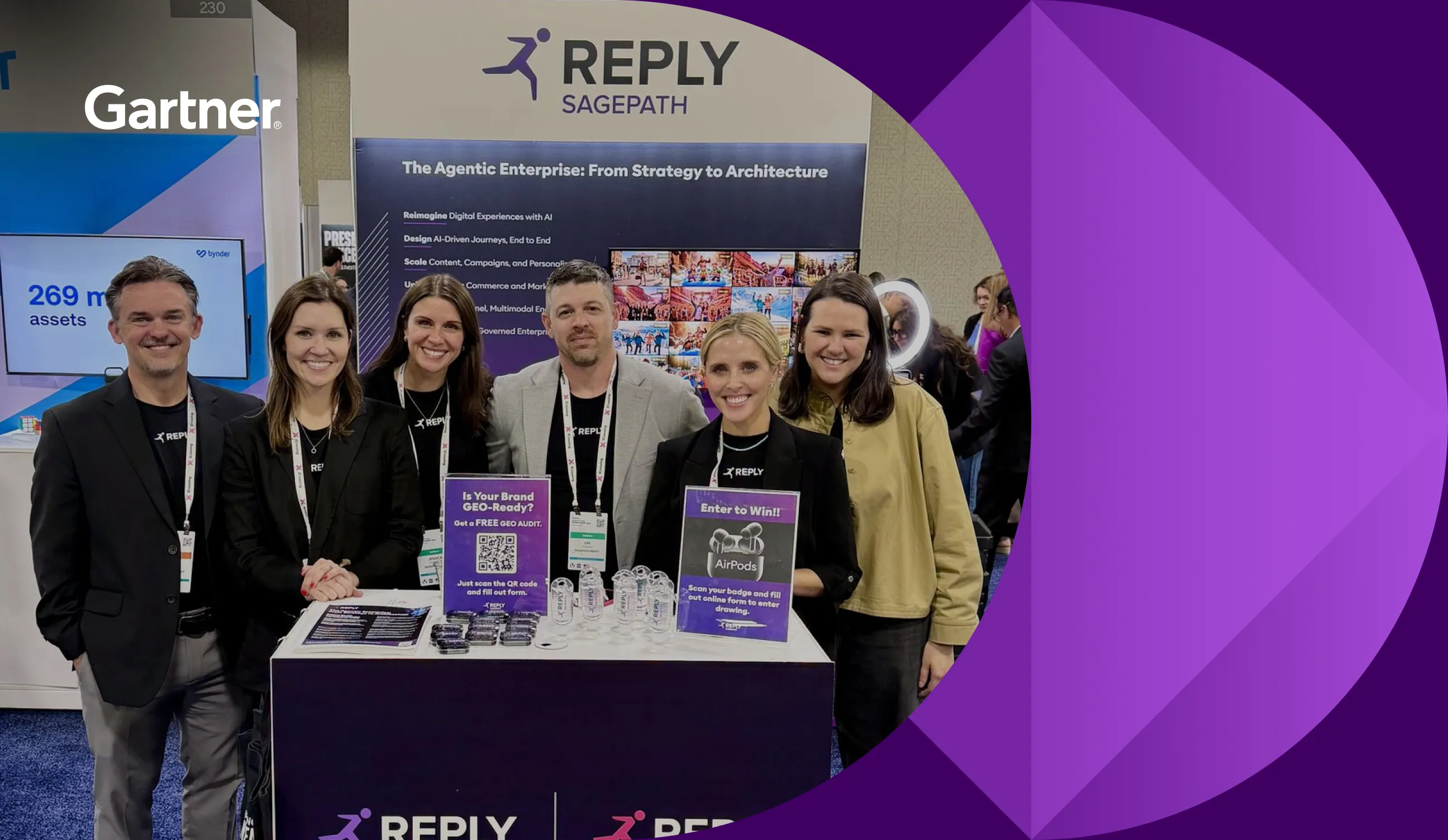
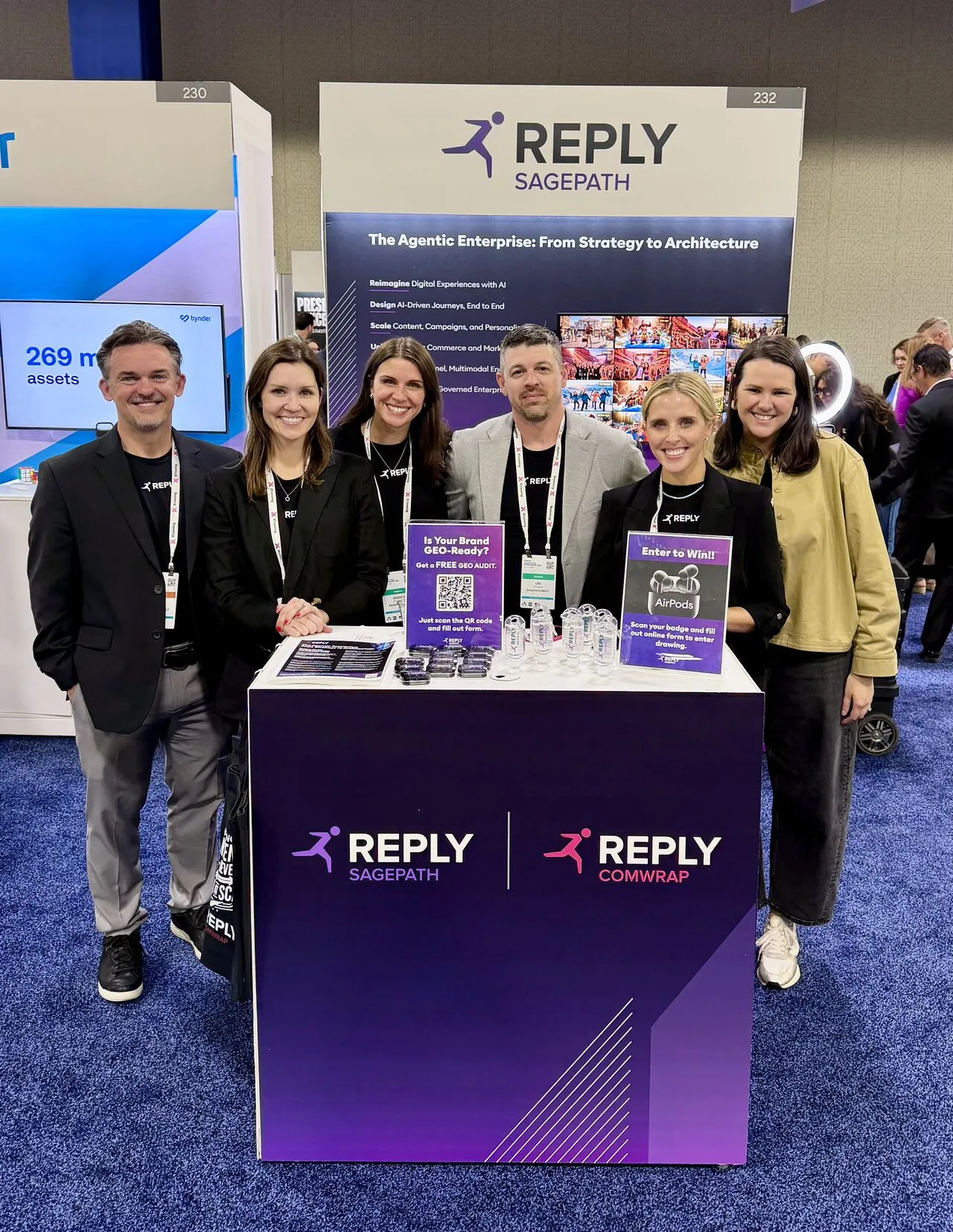
Sagepath Reply attended as an exhibitor at Booth #232 and presented a CMO Boardroom session alongside Premier sponsor Optimizely. What follows is our perspective on the conference, what Gartner emphasized, what we heard from attendees, and where we see the most important work ahead.
How the Conversation Has Evolved
To appreciate what made this year's conference distinctive, it helps to trace the arc. In 2024, the dominant theme was disruption; the "human+" moment, organizations grappling with what AI meant for their people and their work. In 2025, the frame shifted to growth: an "epic journey" framing that leaned into possibility and momentum.
2026 was markedly different in tone. The conversation matured. This year's agenda was organized around AI maturity, governance, and the credibility of the CMO as an organizational AI leader. Whether to adopt AI was settled. Whether organizations have built the discipline, structure, and judgment to use it well; that is the harder question, and Gartner deserves credit for making it the center of gravity.

Before the Conference: A Sagepath Reply Perspective
In the lead up to the symposium, we discussed what we expected the conversation to be, and what we believe the industry is consistently getting wrong in both directions.
Where AI Is Overestimated
Chasing the newest tool. The better question is never "what's the latest model?" It's "does this create business value?" Novelty is not a strategy, and organizations that evaluate AI through a feature lens rather than an outcomes lens will continue to generate activity without building capability.
AI in every customer interaction. The assumption that more AI equals better customer experience is not holding up. Some interactions improve with AI augmentation, while others degrade. Customers are already distinguishing between the two, and blanket deployment is producing measurable CX damage in some categories.
Generative AI for critical business decisions. GenAI is genuinely excellent at content development, summarization, synthesis, and acceleration. It is not a decision engine. Organizations that treat it as one are taking on risk they may not have properly characterized.
Immediate labor elimination. AI automates work, but it also introduces governance requirements, oversight obligations, training demands, and operational complexity. The net headcount math rarely matches the initial projection.
Where AI Is Underestimated
Search and discovery. Customers are increasingly getting answers directly from AI systems rather than clicking through traditional search results. The way people find products, evaluate options, and encounter brands is structurally changing, and most marketing organizations have not fully internalized the implications.
Agent orchestration. This is not about chatbots or copilots. It is about coordinating multiple AI systems, workflows, and people into seamless end-to-end business processes. The operational leverage available here is substantial, and most companies have not begun to access it.
The economics of software. Consumption based AI pricing is quietly reshaping the cost structure of marketing and technology platforms. Most financial models being run today do not account for this shift, which means budget surprises are coming.
Authenticity and trust. AI generated content is now ubiquitous. In that environment, being trusted, credible, and factual is becoming more competitively valuable than being polished or prolific. This is a meaningful strategic reorientation, and one that Gartner's research has directly validated.
The overarching frame beneath all of these points: most organizations are focused on what AI can do today. The bigger, harder conversation is how AI changes the way organizations will operate over the next three to five years. That was precisely the conversation Gartner built this conference around.
What the Conference Said
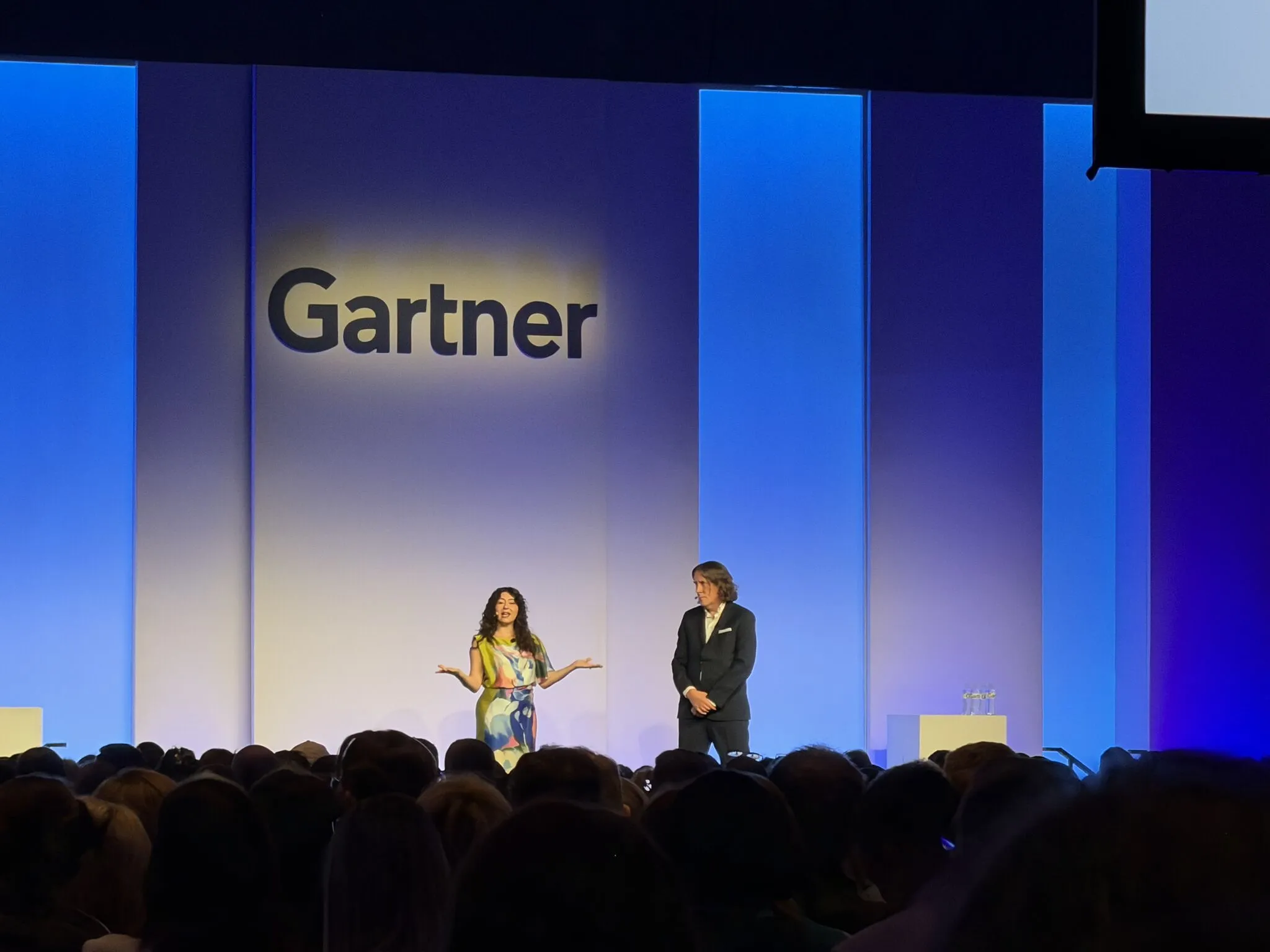
The opening keynote, "Accelerating Marketing's AI Advantage: The Path to 2030," delivered by Kristina LaRocca Cerrone and Jay Wilson set the right tone immediately. Gartner framed AI not as a productivity story but as a maturity and governance agenda. That framing matters and it is the difference between chasing tools and actually building organizational capability.
Several research findings released at and around the conference were pointed in their implications:
- Organic search traffic is projected to decline 50% by 2028, driven by AI mediated discovery displacing traditional search behavior
- 58.5% of U.S. Google searches already end without a click, and users are receiving answers without visiting any website
- LLM referral traffic grew 3× between January and December 2025, signaling the rapid scaling of AI as a discovery channel
- Declining perceived content quality from GenAI is measurable and growing, and audiences are developing sharper instincts for AI generated content, and their assessment of it is worsening
- AI powered disinformation was flagged not as a future risk but as an active brand risk organizations need to manage now. Gartner introduced the concept of a "brand doom loop": over reliance on generated content erodes the trust and distinctiveness that made a brand worth investing in a self-reinforcing degradation cycle.
The session agenda deepened these themes throughout the three days. Matt Moorut's "The Impact of LLMs on Search Marketing Strategy" addressed the structural shift in how customers find and evaluate brands. Alan Lopez's "Train AI Agents to Embody Your Brand" tackled the governance and identity challenges of agentic deployment. "Path to Agentic Commerce: Opportunities and Challenges" from Jason Daigler and Sandy Shen examined where autonomous systems are creating commercial opportunities, and where they are creating risk. Kristina LaRocca Cerrone's "Become a Market Shaper CMO" and Nicole Greene's "Find, Capture and Sustain AI Value" addressed organizational leadership and value realization.
The guest keynote program reinforced the research agenda in unexpected ways. Photographer Platon delivered a meditation on human connection, vulnerability, and what it means to be believed. Behavioral scientist Tali Sharot examined how people process change and make decisions under uncertainty. Paralympic champion and advocate Dylan Alcott brought a different kind of authenticity to a stage otherwise dominated by data and frameworks. In the middle of an AI heavy agenda, these voices landed with force, and their presence felt intentional, not incidental.
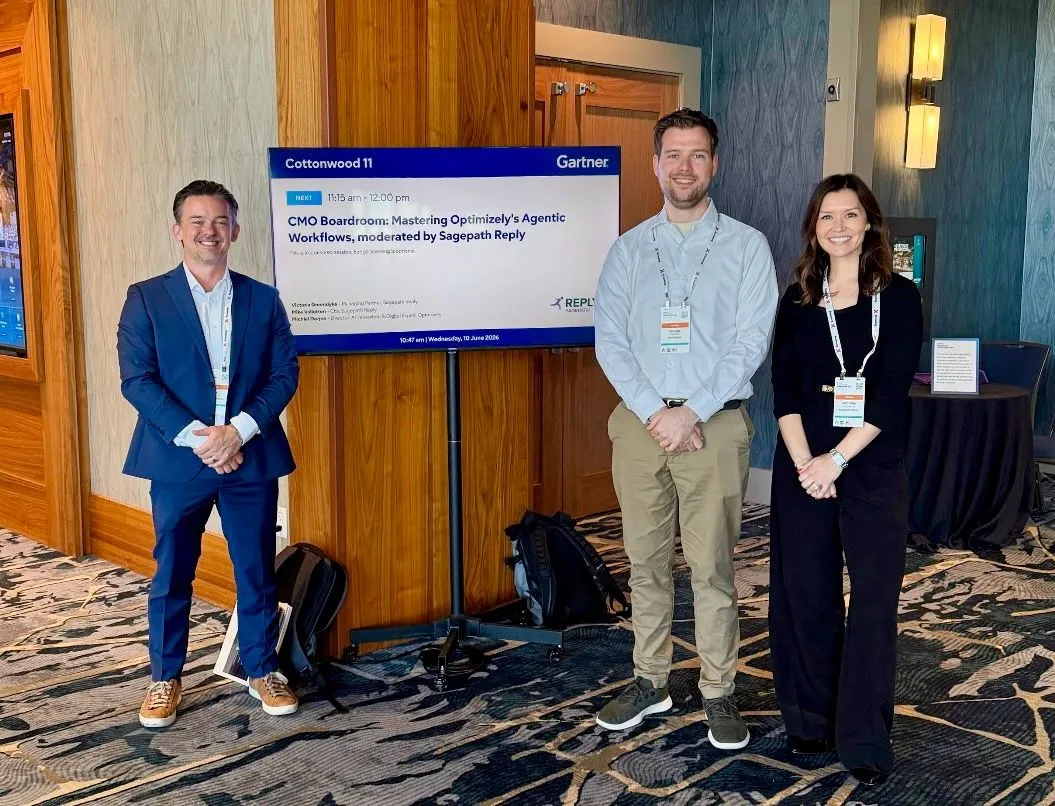
Sagepath Reply presented a CMO Boardroom roundtable titled "AI-Native Marketing: What Every CMO Must Do Now." The session was led by Victoria Greendyke, Managing Partner at Sagepath Reply; Mike Vallotton, CTO at Sagepath Reply; and Michiel Dorjee, Director of AI Innovation and Digital Experience at Optimizely, a Premier sponsor of the symposium and a platform on which Sagepath Reply serves as a Premier implementation and innovation partner.
The central argument: moving from AI pilots to autonomous execution is not primarily a technology decision. It is an organizational and operational one, and it requires a fundamental rethinking of how marketing teams relate to the web itself.
The Agentic Web
The session introduced a framework Sagepath Reply calls The Agentic Web, the structural shift in which discovery and action are collapsing into a single AI mediated loop.
The traditional web journey involves seven steps across multiple touchpoints: awareness, research, comparison, consideration, intent, action, loyalty. The agentic web compresses that to three: Intent → Agent → Outcome. The user states what they need. An AI agent interprets, evaluates, and acts. The customer may never visit a website, engage with a search result, or interact with a brand directly.
The data behind this shift aligns directly with Gartner's research: the 50% projected decline in organic traffic, the 58.5% zero click search rate, and the 3× growth in LLM referral traffic are not projections about what might happen. They are early measurements of a transition already underway. LLM referral traffic is also converting at approximately 18%, a meaningful figure compared to typical organic benchmarks, suggesting that when AI systems do surface a brand, the downstream intent is high.
GEO as the New Visibility Imperative
The strategic implication is direct: Generative Engine Optimization (GEO) must become a primary visibility lever alongside and increasingly ahead of traditional SEO. Citation is the new currency. If AI systems are not citing a brand's content, products, or expertise, that brand is invisible in the channel growing fastest.
Equally important is the measurement gap. Traditional analytics infrastructure does not capture the agentic layer. Organizations are making content and investment decisions based on data that misses a growing share of how customers are encountering and evaluating their brands. This is not a future problem; it is a current blind spot.
The session also introduced Sagepath Reply's Opal Accelerator Programs, a proven framework for building AI-native marketing operations that addresses this transition across content, search strategy, team structure, and automation. The operational model the framework supports involves a deliberate shift: from manual production to AI-generated, human reviewed workflows; from SEO only to GEO and SEO on a dual track; from siloed functional teams to unified agentic marketing pods; and from reactive campaign management to predictive, AI driven decision making.
What the Room Actually Said
The roundtable was structured as a conversation, not a presentation. What came back from the attendees was grounding and, in some respects, sobering.
Most attendees reported seeing a 10–20% drop in website traffic, with the majority correctly attributing it to AI mediated research behavior. The traffic is not going to competitors. It is going to AI interfaces that answer the question and move on without generating a visit.
Despite that external pressure, internal AI adoption remains surprisingly limited. The gap between what these leaders are observing in the market and what their organizations have actually changed in response is real, and it was acknowledged openly.
The specific apprehensions the room surfaced:
- Growing demand for structured, specific content that AI systems can actually parse, evaluate, and cite versus the broadly optimized content most teams are still producing
- Higher content volume requirements to build meaningful GEO and AEO visibility at scale
- The need for internal automation and business process efficiency, not just externally facing AI applications
- The expectation that marketing lead organizational technology adoption, a role the function has played before, and is being asked to play again with greater consequence
- Flat budgets, unchanged team sizes, and materially higher expectations
That last combination is not new. What is different in this cycle is the scale of the asks being placed against constrained resources, and the speed at which the underlying environment is changing beneath them.
The Bottom Line
Gartner's framing this year was correct: this is a maturity and governance conversation, not a tools conversation. The organizations that come out ahead will not be those with the most AI implementations. They will be the ones that have built the operational discipline to use AI well, to know where it adds value and where it introduces risk, to govern its output, and to adapt their structure to a world where the customer journey no longer runs through the channels they built their programs around.
The Agentic Web is not a future scenario. It is the present condition of an accelerating transition. The brands that show up in it will be the ones that built the content infrastructure, the measurement capability, and the operational model before it became obvious that they needed to.
Is your organization ready? Do you know whether your brand is being cited, surfaced, or passed over entirely by the AI systems your customers are already using? The Agentic Web is not a future scenario; it is here, and the distance between organizations that prepared and those that didn't is widening every quarter.
This is what Sagepath Reply does. Digital transformation, AI-native operations, agentic marketing infrastructure, business process modernization, we don't just advise on it. We build it. If you're ready to understand where you stand and what it takes to show up in the world your customers already live in, we'd like to be the team that gets you there.