Ripping off the Agentic Marketing Band A.I.d
Helping Marketers go from AI Ambiguity to Approachable Adoption.
In this recap, we share practical lessons from a hands-on Agentic Orchestration Workshop with Optimizely, including how marketers used Optimizely Opal, which AI use cases resonated most, and what teams need to move from AI experimentation to operational adoption.
Key Takeaways
- Marketers responded strongly to practical use cases like GEO auditing, competitor analysis, and content generation.
- Optimizely Opal’s usability, security posture, and integration with the Optimizely DXP helped participants see AI as operationally viable.
- Successful AI adoption requires strategy, governance, measurement, and human oversight.
- Hands-on experimentation reduced AI apprehension more effectively than presentation-only education.
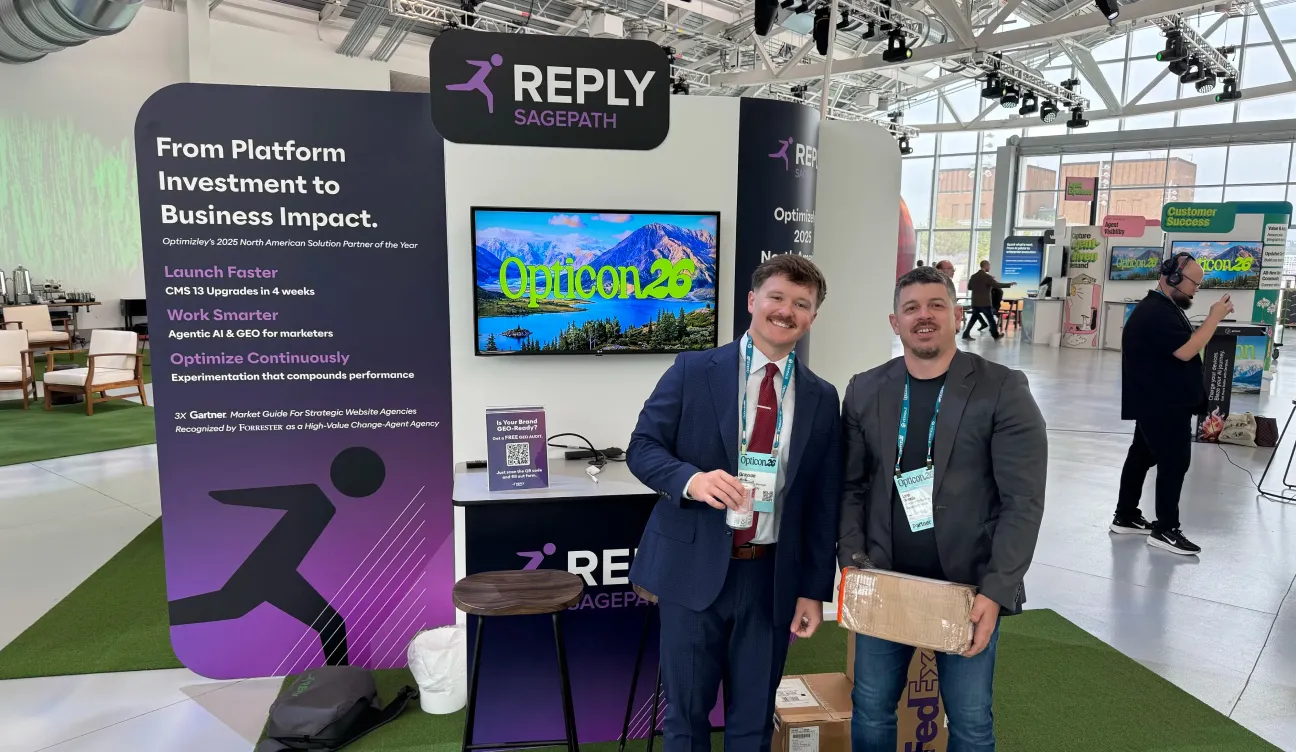
Recently, we partnered with Optimizely to host an Agentic Orchestration Workshop in Atlanta, a hands-on afternoon built around a simple but ambitious goal: help marketers move beyond pilots and PowerPoints and start building and deploying real AI agents inside their own marketing ecosystems.
Too many AI conversations stall in the theoretical. We need a little less talk and a lot more action. Leaders know AI matters, and teams have sat through plenty of demos. But the distance between “we should be using AI” and “here’s an agent we built and put to work” can feel a bit daunting.
We designed this workshop to close that gap in a single afternoon with hands on keyboards, not just slides on a screen. Here’s what we saw, what worked, and what it means for any marketing team standing at the edge of real AI adoption.
What is An Agentic Orchestration Workshop?
The most important decision we made was structural: we built the day around experimentation rather than presentation. Most of the marketers in the room were relatively new to AI, and several were understandably cautious about it, which is exactly the audience in this format was designed for. Rather than talk at them about what AI could theoretically do, we gave each participant their own sandbox access in Optimizely Opal, asked them to bring their own laptops, and let them dig in. There’s something about getting your hands directly into a tool that relieves apprehension. A bit like pulling off a big, scary band-aid and discovering that what’s underneath was never scary at all.
A few deliberate choices made that possible.
- Provide Different Perspectives: We split the opening presentation across multiple presenters, each bringing different expertise, which kept energy and attention high.
- Be Relatable. Be Human: We kept the materials and activities approachable to ease new-adopter nerves, while consistently reinforcing the importance of keeping a human in the loop.
- Make AI Enjoyable: Loosely borrowing from Summer House Reality Star, Kyle Cooke, “AI Should be FUN!” ...and we made every effort to make and keep the day genuinely entertaining. Our partnership with Optimizely works well because while we are both passionate about the work we do for our customers, we don’t take ourselves too seriously. (It also didn’t hurt that the afternoon wrapped up with sim racing at an F1 Arcade).
How Marketers Used Optimizely Opal During the Workshop
Once participants were actually in the tool, a consistent set of reactions began to emerge.
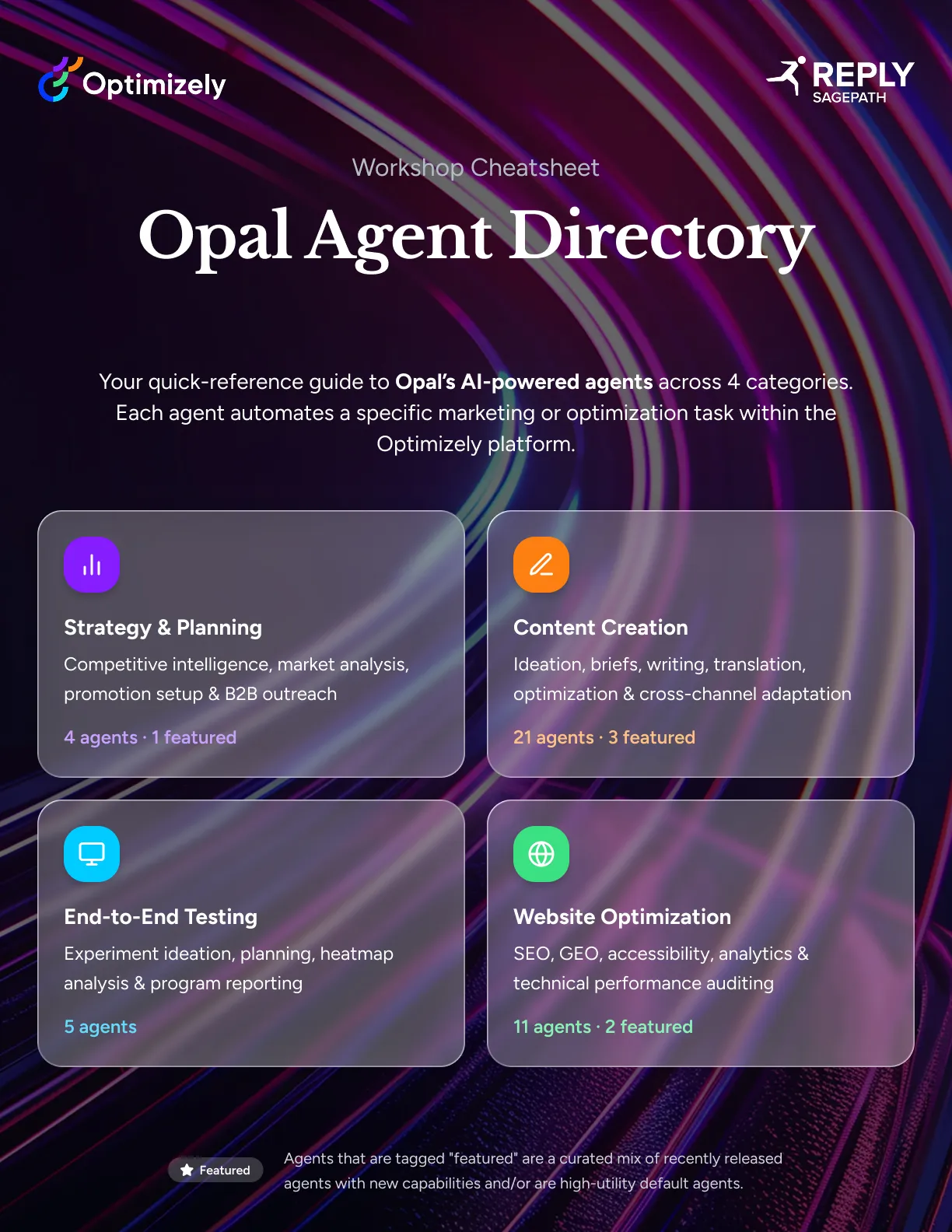
- Ease of Use: The first was simple relief at how intuitive Opal felt. Many participants commented on its ease of use and how quickly they found their footing. The short description blurbs and clear categorization of agents earned particular appreciation. It takes the guesswork out of choosing the right agent and helps prevent misuse.
- Multitasking Capabilities: One small workflow discovery turned out to be a big one. When participants were waiting ona longer or more complex promptsto generate, we showed them they could open additional chats and run other experiments in parallel. Being able to research several things at once was, for many, a genuine “aha” moment. The Canvas feature, which lets you edit outputs directly, was another clear favorite.
- Prompting Made Simple: Prompt engineering proved far less intimidating than expected. Using the CLEAR framework, (if you're not familiar with it, Optimizely's AI marketing playbook breaks it down in full) participants picked up prompt composition quickly, with only light guidance needed. We took something that often is seen as complex and made it become an easy-to-remember best practice. Opal’s image generation impressed the room as well, both for the diversity of its capabilities and the speed of delivery.
- Secure & Streamlined Experience: Two themes mattered especially for participants with heavy compliance obligations. On security, many were reassured to learn that their inputs stayed secure and that their information sharing did not feed public large language models. And because Opal is fully integrated into the Optimizely DXP, it felt like a true one-stop shop for existing Optimizely customers. And for the participants who are non-Optimizely users? They showed some real openness to adopting Opal as a plug in after spending hands-on time in the tool.
- Accessibility: Rather than closing Opal sandbox access once the workshop ended, every participant left with a 30-day trial. That window keeps Opal top of mind, encourages continued exploration, and lets people experiment on their own terms — without an instructor looking over their shoulder.
What AI Use Cases Resonated Most with Marketing Teams
Three use cases stood out as immediate, practical wins.
GEO Auditor. This one was a hit across the board. As the industry adapts to generative engine optimization, Opal’s GEO Auditor produces a clear, straightforward report that lets teams improve their keyword strategies right away, all while building an understanding of why GEO belongs in their longer-term strategy.
Competitor analysis. This sparked a lot of curiosity. A client in the financial industry, for example, was especially interested in how their brand stacked up against competitors in their tier. We watched some participants use existing pre-built agents to gather that intelligence, and others copy a pre-built agent and add their own brand-specific layers for more tailored output. An encouraging early sign of people starting to think like builders.
Content generation. Simple, but valuable. Many participants appreciated Opal’s recommendations for expanding an existing piece of content and reframing it for other owned channels. For marketers who live in their content every day, that outside perspective surfaces easy wins that can be genuinely hard to see from the inside.
What Marketing Teams Need for Real AI Adoption
If one thread ran through the entire afternoon, it was this: getting real value from AI takes more than isolated experiments. Success requires a comprehensive strategy aligned with business goals. It also requires treating AI as an embedded operational capability rather than a one-off initiative and continuously measuring its impact, so the approach improves over time.
That mindset shift is what we want every participant to carry forward. The tools are ready, and they’re far more approachable than most people realize. By design, this workshop was a foundational model. It served as a structure we can repeat for any team at a similar stage in its AI journey.
How Sagepath Reply Helps Teams Operationalize AI
Sagepath Reply helps marketing teams evaluate, implement, and operationalize AI-enabled digital experience workflows across content, commerce, personalization, and marketing technology ecosystems.
When your team is ready to move from AI ambition to measurable execution, we’d love to help you get there. Reach out to schedule a workshop with us at sagepath-reply.com/contact/
In the meantime, remember that the band-aid is far easier to pull off than you think.
Footnotes
- [1] https://docs.developers.optimizely.com/content-management-system/docs/optimizely-opal
- [2] https://developers.google.com/search/docs/fundamentals/ai-optimization-guide
- [3] https://sagepath-reply.com/platforms/optimizely/
- [4] https://sagepath-reply.com/ai-native-solutions/generative-engine-optimization/
- [5] https://sagepath-reply.com/ai-native-solutions/digital-experience-platforms/
About the Author:
Ali Mansfield, Head of Content | Sagepath Reply
Ali Mansfield brings nearly two decades of experience in B2C and B2B digital communications. After a full agency career — including roles at Ogilvy and Edelman — she joined Sagepath Reply in 2021, where she helps clients integrate AI solutions, such as Opal, into their marketing business processes. A storyteller at heart, Ali believes the power of human creativity, paired with the right AI integration strategy, can create remarkable customer experiences that drive real business results.